Building software is only one part of building a successful digital product.
A team can write clean code and still end up with a product that is difficult to use, expensive to maintain, slow to scale, or disconnected from what customers actually need. Product engineering addresses that wider problem.
It connects product decisions with design, architecture, software development, testing, infrastructure, security, and continuous improvement.
This guide explains how software product engineering works, what the process looks like, where it differs from traditional software development, and what businesses should consider when moving from an idea or MVP toward a scalable product.
What Is Software Product Engineering ?
Software product engineering is the process of designing, building, testing, launching, operating, and continuously improving a digital product throughout its lifecycle.
It combines software engineering with product strategy, user experience, technical architecture, quality engineering, DevOps, security, analytics, and ongoing product improvement.
IBM describes product engineering as applying engineering principles across a product lifecycle, including design, development, testing, and optimization.
For software companies, the focus is not simply:
Can we build this feature ?
The engineering team also needs to consider:
- Does the feature solve a real user problem ?
- Is it worth building now ?
- Will it fit the existing architecture ?
- Can it be tested and released safely ?
- What happens when usage increases ?
- Can another engineer maintain it later ?
- How will we know whether the feature worked ?
Software product engineering therefore treats the product as an evolving system rather than a one-time software project.
Software Product Engineering vs. Software Development
Software development and product engineering overlap, but they are not exactly the same.
Software development focuses primarily on creating and maintaining software. Product engineering adds a stronger product-lifecycle perspective.
| Area | Software Development | Software Product Engineering |
|---|---|---|
| Primary focus | Building software | Building and evolving a product |
| Starting point | Requirements | User and business problem |
| Scope | Feature or application | Full product lifecycle |
| Architecture | Supports current requirements | Balances current needs with future evolution |
| UX | May be handled separately | Closely connected to engineering decisions |
| Launch | Major delivery milestone | Beginning of the next learning cycle |
| Scaling | Addressed as needed | Considered throughout product evolution |
| Success | Software works correctly | Product delivers value and remains maintainable |
A company can have capable developers and still struggle with product engineering if product decisions, user needs, architecture, and engineering priorities are disconnected.
Want a practical perspective? This Y Combinator discussion explores how product engineers combine software development with customer understanding, product decisions, and ownership as startups grow.
What Does Software Product Engineering Include ?
A mature product-engineering function usually covers several connected disciplines.
Product discovery
The team identifies the user problem, business objective, constraints, assumptions, and expected outcome before committing heavily to development.
Product definition
The problem is converted into priorities, workflows, requirements, user stories, and a realistic product roadmap.
UX and product design
Designers map user journeys, create interfaces, validate workflows, and reduce usability problems before they become expensive engineering changes.
Technical architecture
Engineers decide how the frontend, backend, databases, APIs, infrastructure, authentication, integrations, and supporting systems should work together.
Software development
The team builds the product using technologies appropriate for its requirements, expected scale, and long-term maintenance.
Quality engineering
Testing covers functionality, integrations, regression risks, performance, security, and other product-critical behavior.
DevOps and infrastructure
CI/CD, deployment, cloud infrastructure, monitoring, backups, and operational controls support reliable releases.
Product analytics
Usage data helps teams understand adoption, workflow problems, feature value, and opportunities for improvement.
Scaling and optimization
Architecture, databases, infrastructure, code, and internal processes are improved as the product grows.
Product modernization
Older components can be replaced or improved without automatically rebuilding the entire system.
How Does the Product Engineering Process Work ?
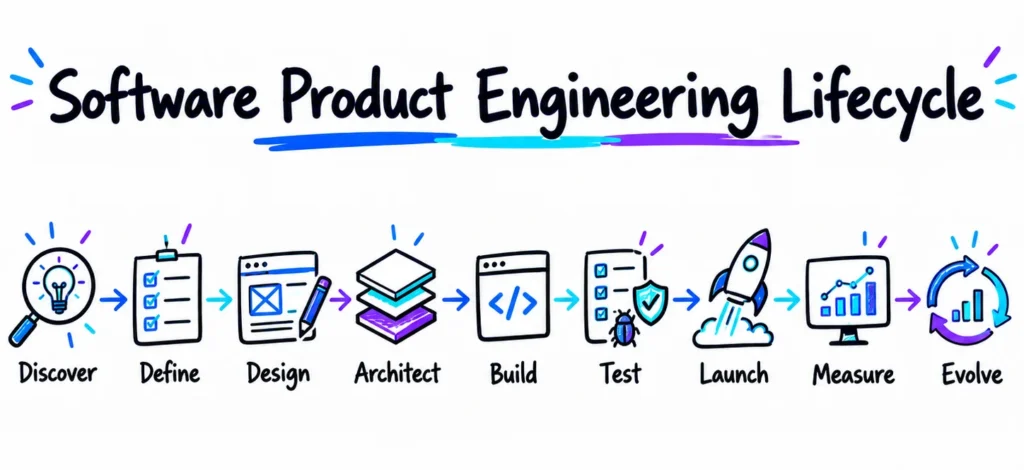
The exact product engineering process depends on the product’s maturity, team, users, technical environment, and business goals.
A startup validating a new SaaS idea should not follow exactly the same process as a mature platform modernizing a ten-year-old system.
Still, most successful product-engineering programs move through the following stages.
1. Discover the Problem
Start with the problem rather than the requested feature.
A stakeholder might initially say:
We need an analytics dashboard.
Product discovery should go deeper:
What decision are users currently unable to make with the information they have ?
The answer may reveal that users need an alert, automated report, search feature, workflow improvement, or integration instead of another dashboard.
Discovery can examine:
- Target users
- Business goals
- Existing workflows
- Pain points
- Assumptions
- Technical constraints
- Existing systems
- Competitive alternatives
- Success criteria
The purpose is not to eliminate every unknown. It is to identify the assumptions that matter most before expensive development begins.
2. Define Scope and Priorities
After understanding the problem, decide what belongs in the first meaningful release.
A useful roadmap separates:
- Essential capabilities
- Valuable but noncritical capabilities
- Future ideas
For an early-stage product, the goal may be validating the core value proposition.
For an established platform, priorities might instead involve:
- Reliability
- Scalability
- Customer retention
- Revenue features
- Integrations
- Technical debt
- Modernization
- Operational efficiency
Product engineering is partly the discipline of deciding what not to build yet.
3. Design the Product Experience
Engineering should not begin with screens that have never been tested against real workflows.
Product design may include:
- User journeys
- Information architecture
- Wireframes
- Prototypes
- Interface design
- Accessibility
- Usability validation
A prototype can reveal questions that requirement documents often miss.
Can users understand what happens next ?
Are important actions easy to find ?
Does a workflow contain unnecessary steps ?
What information does the user need at each stage ?
Resolving these questions early reduces expensive changes later.
4. Design the Technical Architecture
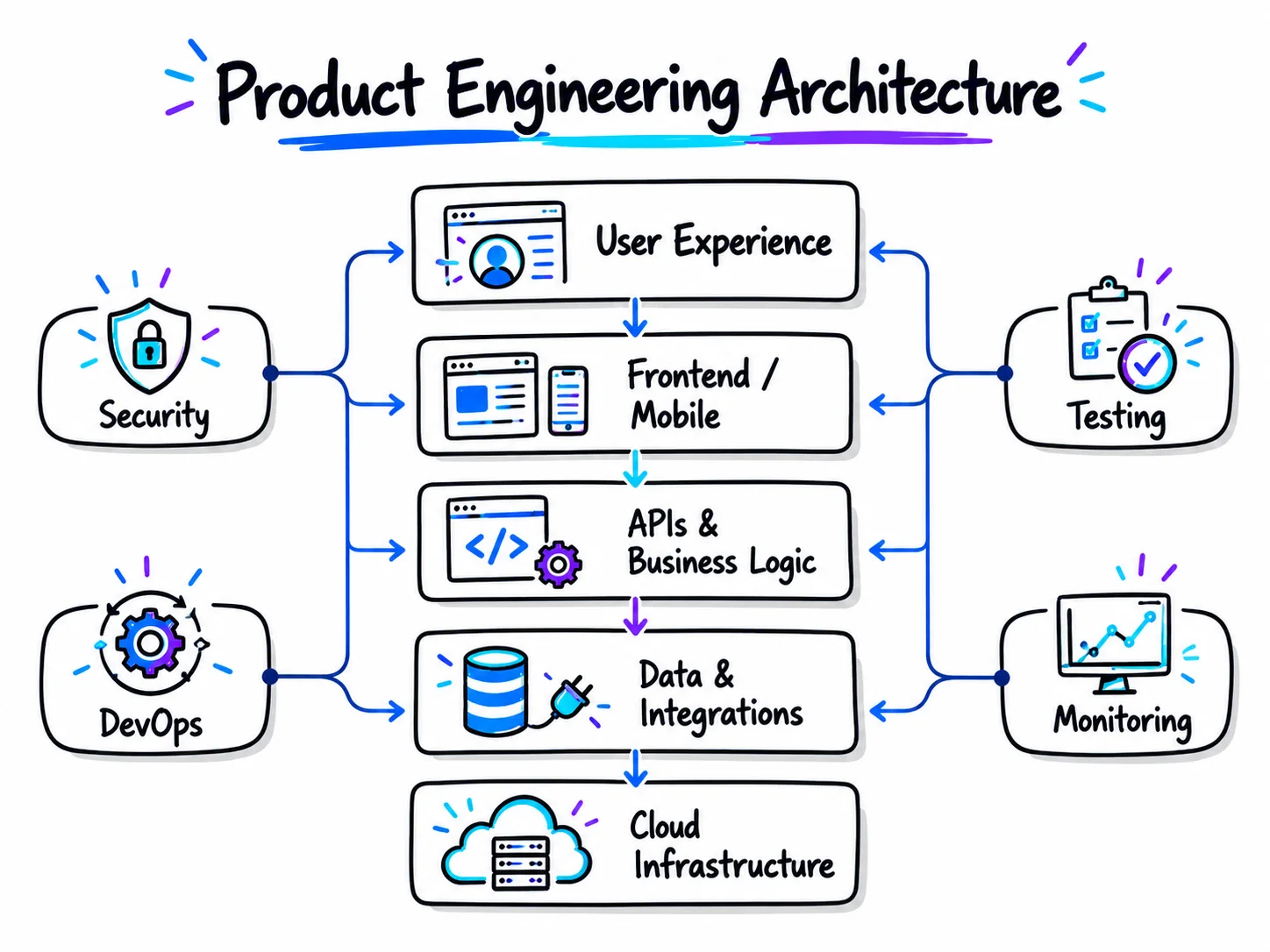
Once the product direction is clear, the team can design an architecture that supports the first release without making future changes unnecessarily difficult.
A typical digital product may include:
Frontend layer
Web or mobile interfaces used by customers or internal teams.
Application layer
Business rules, workflows, backend logic, and services.
API layer
Communication between frontend applications, internal services, and external platforms.
Data layer
Relational databases, document databases, caching systems, search indexes, or analytics stores.
Identity layer
Authentication, authorization, user roles, and permissions.
Integration layer
Payments, CRM systems, communication platforms, analytics tools, and third-party services.
Infrastructure layer
Cloud hosting, containers, storage, networking, deployment environments, and delivery systems.
Observability layer
Logs, application metrics, tracing, error tracking, and alerts.
The objective is not to build the most advanced architecture possible. The architecture should be suitable for the product’s current needs while leaving sensible paths for growth.
Do You Need Microservices From Day One ?
Usually not.
Early-stage products often benefit from simpler architectures because fewer distributed components mean less deployment overhead, easier debugging, and faster development.
A modular monolith can be a sensible starting point when the product is still evolving quickly.
Microservices become more useful when there are clear reasons for them, such as:
- Independent scaling needs
- Strong domain boundaries
- Multiple engineering teams
- Different deployment requirements
- Fault-isolation requirements
- Substantial service complexity
Architecture should respond to actual product and engineering problems rather than imitate the architecture of much larger companies.
5. Build the MVP or Product Version
Once the product and architecture are defined, the team turns priorities into working software.
Development should include appropriate engineering practices such as:
- Version control
- Code review
- Automated testing
- CI/CD
- Environment separation
- Error handling
- Security controls
- Acceptance criteria
- Useful technical documentation
An MVP can have limited scope without having careless engineering.
For example, an MVP may intentionally postpone advanced reporting or complex integrations.
It should not intentionally use weak authentication or unsafe data handling simply because it is an early version.
6. Test the Product Properly
Testing should answer more than whether individual buttons and screens work.
Depending on the product, quality engineering can include:
- Unit testing
- Integration testing
- End-to-end testing
- Regression testing
- Usability testing
- API testing
- Accessibility testing
- Load testing
- Performance testing
- Security testing
Security should also be integrated throughout development rather than treated as a final pre-launch check.
NIST’s Secure Software Development Framework recommends incorporating secure development practices into the software development lifecycle because many traditional SDLC models do not address software security in enough detail.
7. Launch With Production Readiness in Mind
Launch is not simply the moment when the application becomes publicly accessible.
The team needs to know what happens when real users begin interacting with it.
Production readiness can include:
- Automated deployments
- Backups
- Monitoring
- Error tracking
- Application logging
- Alerts
- Rollback procedures
- Support workflows
- Security controls
- Infrastructure capacity planning
Teams should also monitor product and technical indicators such as:
- Application errors
- Response times
- API failures
- Database performance
- Infrastructure usage
- Feature adoption
- Conversion events
- Workflow abandonment
A product that cannot be observed is difficult to improve reliably.
8. Learn From Real Usage
Once customers use the product, assumptions can be replaced with evidence.
Teams should investigate:
- Which features are actually used
- Where users abandon workflows
- Which support issues appear repeatedly
- Which technical failures occur
- What customers request
- Where performance deteriorates
- Which features create measurable value
The product-engineering cycle then becomes:
Build → Measure → Learn → Prioritize → Improve
Not every customer request should automatically become a feature. Usage patterns and business priorities should help determine what deserves engineering effort.
9. Scale What Has Been Proven
Scaling should normally follow validation rather than precede it.
And scaling is broader than increasing server capacity.
Growth can create pressure across several areas.
Architecture:
The original system structure may no longer match product complexity.
Data:
Queries that performed well with thousands of records may behave differently with millions.
Infrastructure:
Growth may require caching, queues, autoscaling, CDN delivery, or more resilient services.
Operations:
Manual onboarding, administration, or support processes may become bottlenecks.
Engineering teams:
One team may become several teams that need clearer ownership and boundaries.
Release processes:
Manual deployments may become unsuitable as release frequency increases.
Product experience:
Workflows designed for one customer type may become difficult to use as the audience broadens.
Product scaling is therefore both a technical and operational problem.
From MVP to V1: What Changes ?
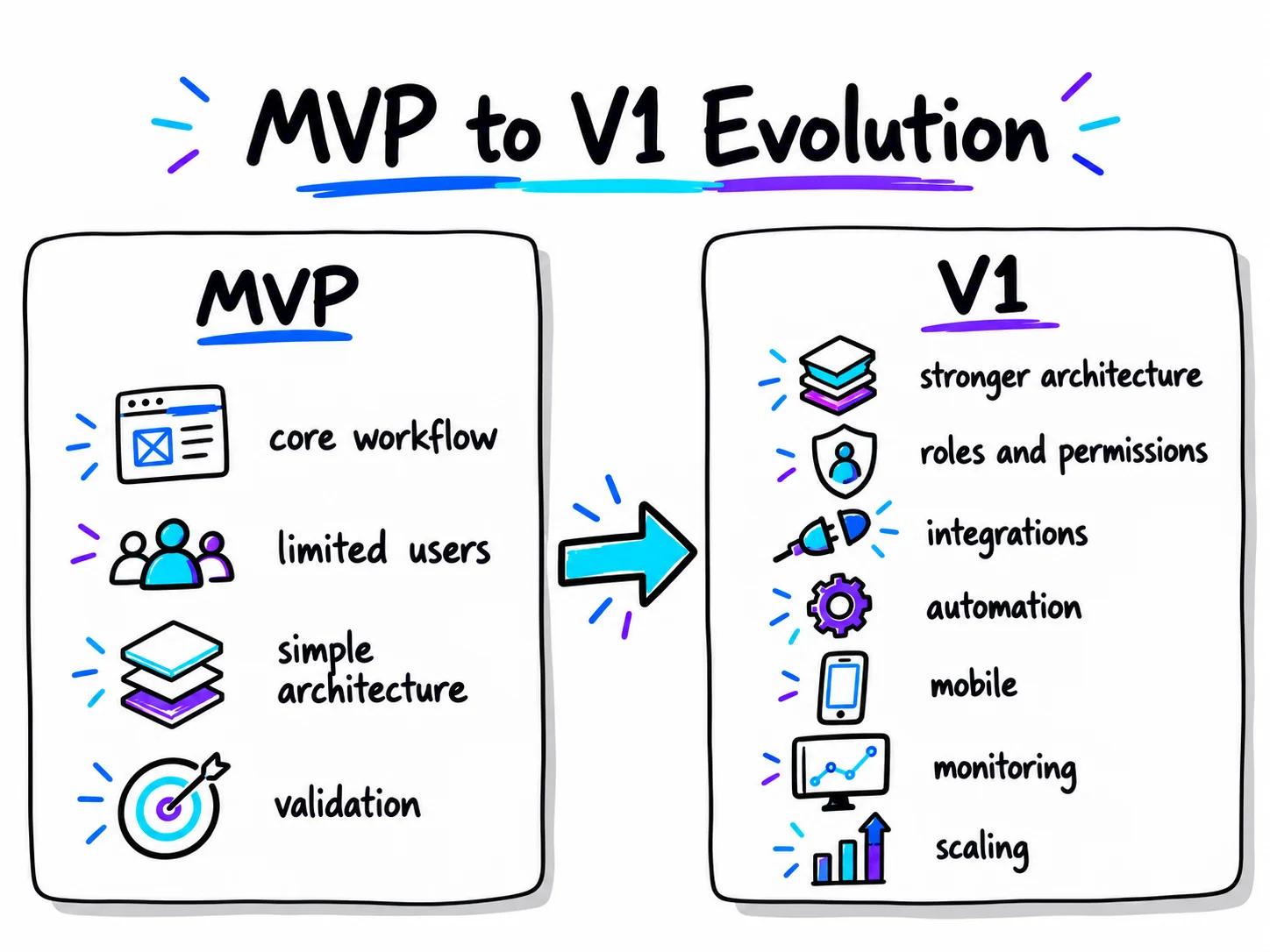
An MVP and a V1 serve different purposes. An MVP is primarily designed to test whether the core product idea creates enough value to justify further investment. Once that value has been validated, the engineering priorities usually shift toward reliability, scalability, security, integrations, and operational efficiency.
Once that value has been demonstrated, the priorities usually change.
The next version may require:
- Stronger architecture
- Better security
- Improved permissions
- More robust workflows
- Integrations
- Internal administration tools
- Mobile support
- Better monitoring
- Improved reliability
- Support for more users or markets
The useful question at this stage is not:
How many new features should we add ?
It is:
What does the product need to reliably support the next stage of the business ?
That mindset prevents V1 from becoming an oversized feature release.
A good example is Air Brite Labs’ MVP-to-V1 product engineering case study. The telehealth product had already proven its core booking and consultation workflows, so the next stage was not a full rebuild. The team preserved those validated experiences while strengthening scheduling, infrastructure, permissions, insurance workflows, mobile access, and internal operations.
According to the published case study, the platform expanded from one city to three, approximately 35% of bookings used insurance within the first two months, and mobile adoption reached roughly 60% of active patients within 90 days, while existing users were migrated without data loss.
When Should an MVP Become V1 ?
Common signals include:
- Users are returning consistently
- The core workflow has been validated
- Customers are requesting similar improvements
- Manual operations are becoming difficult
- Growth exposes architecture limitations
- More user roles are required
- Stronger integrations are necessary
- Security expectations have increased
- The business is entering new markets
- Internal support tools are needed
At this stage, the question changes.
The MVP asks:
Does this product deserve further investment ?
V1 asks:
Can this product reliably support the business we are building ?
Common Software Product Engineering Use Cases
Here are some of the most common situations where structured product engineering creates value:
MVP Development
Turning an early concept into a focused product that can test critical assumptions with real users.
MVP-to-V1 Development
Strengthening a validated product with better architecture, reliability, functionality, integrations, security, and operational capabilities.
SaaS Product Development
Building subscription software with user accounts, permissions, billing, integrations, analytics, and scalable infrastructure.
Product Scaling
Improving architecture, infrastructure, databases, workflows, and engineering practices as usage grows.
Product Modernization
Replacing outdated technologies or architecture while preserving valuable workflows and minimizing disruption.
New Feature Engineering
Adding significant capabilities without creating unnecessary technical debt or breaking existing behavior.
Product Performance Optimization
Improving application speed, reliability, database performance, infrastructure efficiency, or user experience.
Platform Engineering
Building a shared technical foundation capable of supporting multiple workflows, user groups, products, or integrations.
What Makes a Software Product Scalable ?
Scalability has several dimensions.
Technical scalability
Can the application, infrastructure, database, and integrations support increased usage ?
Product scalability
Can the same product serve more users without constant custom development ?
Operational scalability
Can onboarding, support, billing, administration, and internal workflows grow efficiently ?
Organizational scalability
Can additional engineers or teams work on the product without constantly blocking one another ?
Economic scalability
Does operating cost remain reasonable as usage increases ?
A product may handle millions of requests technically while still requiring employees to manually configure every new account.
That product has infrastructure scale, but it does not yet have operational scale.
What Technologies Are Used in Digital Product Engineering ?
There is no universal product-engineering technology stack.
A digital product may use combinations of:
- React or Next.js for web applications
- React Native or Flutter for mobile applications
- Node.js, Python, Java, or .NET for backend services
- PostgreSQL, MongoDB, or other databases
- REST or GraphQL APIs
- AWS, Azure, or Google Cloud
- Containers and orchestration platforms
- Caching systems
- Search infrastructure
- CI/CD platforms
- Monitoring and observability tools
Technology selection should depend on:
- Product requirements
- Engineering expertise
- Expected scale
- Security requirements
- Data requirements
- Integrations
- Hiring availability
- Operational complexity
- Long-term maintenance
The newest framework is rarely valuable simply because it is new.
The better choice is the stack the team can operate reliably over the life of the product.
How AI Is Changing Product Engineering
AI is becoming part of both the products teams build and the engineering workflows used to build them. Gartner’s research on AI-native software engineering predicts that 90% of enterprise software engineers will use AI code assistants by 2028, up from less than 14% in early 2024. Gartner also expects at least 55% of software engineering teams to be actively building LLM-based features by 2027.
This creates two separate opportunities.
AI inside the product
Products can add:
- Intelligent search
- Recommendations
- Copilots
- Conversational interfaces
- Document processing
- Automation
- Summarization
- Predictive capabilities
AI inside the engineering workflow
Teams can use AI to assist with:
- Code generation
- Testing
- Documentation
- Debugging
- Code review
- Migration
- Prototyping
But AI does not remove the need for architecture, review, testing, security, and product judgment.
It changes where engineering effort is spent.
Common Product Engineering Mistakes
Here are some of the most common mistakes that make digital products harder to launch, maintain, or scale:
Building Too Much Before Validation
A long feature list creates risk when the core product assumptions have not been tested.
Treating an MVP as Disposable Code
Reduced scope can accelerate validation. Weak security, poor data handling, and unmaintainable foundations create different problems.
Designing for Hypothetical Scale
Building highly distributed architecture before demand exists can slow development without creating meaningful value.
Ignoring Real User Workflows
Technically correct software can still fail when completing a basic task is unnecessarily difficult.
Rebuilding Too Early
A focused refactor or incremental modernization may deliver more value with less risk than replacing an entire working system.
Ignoring Technical Debt
Some technical debt is intentional. Problems begin when nobody knows what shortcuts were made or why.
Separating Product and Engineering Decisions
Product decisions affect architecture. Architecture affects what the product can become.
The two cannot operate effectively in isolation.
Launching Without Monitoring
If the team cannot see failures, latency, usage, or abnormal behavior, it will struggle to understand production problems.
When Should You Modernize Instead of Rebuild ?
A full rewrite is not automatically the best answer to an aging product.
Modernization may make more sense when:
- Core workflows still create customer value
- Users rely on existing behavior
- Only specific components limit growth
- Data structures remain useful
- Parts of the system can be replaced incrementally
A rebuild becomes more reasonable when:
- Foundational architecture prevents important changes
- Critical technologies are no longer supported
- Serious security problems cannot be resolved safely
- The system cannot be tested reliably
- Original product assumptions have fundamentally changed
- Maintaining the system costs more than replacing it
The decision should be based on evidence, risk, and business priorities rather than frustration with old code.
What Determines Software Product Engineering Cost ?
There is no single product-engineering price because complexity varies widely.
The main cost drivers usually include:
Scope
More workflows, roles, features, and platforms require more product, design, and engineering work.
Product maturity
Building from an idea differs substantially from modernizing a product with years of accumulated technical decisions.
Architecture
Real-time systems, multi-tenant SaaS platforms, complex permissions, and distributed applications increase complexity.
Integrations
Payment providers, CRMs, ERPs, identity systems, communication tools, and customer platforms all require implementation and testing.
Security requirements
Products that handle sensitive information need stronger access control, logging, testing, and operational safeguards.
Mobile applications
Supporting mobile introduces another interface, testing surface, and release process.
Quality expectations
An internal prototype and a customer-facing platform handling critical transactions require different levels of reliability.
Infrastructure
Cloud hosting, databases, monitoring, storage, third-party APIs, and traffic contribute to ongoing costs.
Post-launch development
Software products continue changing after launch.
The real budget therefore includes both the initial build and continued product evolution.
How Long Does Product Engineering Take ?
The timeline depends on scope, complexity, uncertainty, and product maturity.
Important factors include:
- Clarity of requirements
- Design complexity
- Architecture
- Integrations
- Team size
- Data migration
- Security requirements
- Testing requirements
- Existing technical debt
- Stakeholder feedback cycles
Rather than asking:
How quickly can we build everything ?
A better question is:
What is the smallest valuable release we can put in front of users with confidence ?
That creates a more practical roadmap and provides earlier evidence for future decisions.
How to Evaluate Product Engineering Services
When evaluating product engineering services, look beyond programming languages and team size.
Ask how the provider approaches:
Product discovery:
Can they explain the problem the product is solving ?
Prioritization:
Can they separate necessary functionality from unnecessary scope ?
Architecture:
Can they explain technical trade-offs in business terms ?
UX:
Do engineering and design decisions reflect actual user workflows ?
Security:
Is secure development integrated into the delivery process ?
Quality:
How are regressions, integration issues, and performance problems tested ?
DevOps:
Can releases be deployed predictably and monitored in production ?
Scalability:
What assumptions are being made about future usage ?
Technical debt:
How are short-term compromises documented and managed ?
Post-launch development:
How will the product be maintained and improved after release ?
A good engineering partner should also be comfortable explaining when a requested technology or architecture is unnecessary.
What Does a Production-Ready Digital Product Look Like ?
A production-ready product should be:
Useful: It solves a clear customer or business problem.
Validated: Important assumptions have been tested with evidence.
Usable: Customers can understand and complete core workflows.
Reliable: Critical functionality behaves consistently.
Secure: Appropriate controls are integrated throughout development.
Observable: The team can identify errors and performance problems.
Deployable: Releases can be delivered predictably.
Maintainable: Engineers can understand and safely change the system.
Scalable: The architecture can evolve as real demand grows.
Measurable: Product and technical performance can be evaluated using clear signals.
Recoverable: Failures have defined fallback, rollback, and recovery paths.
Evolvable: New requirements can be added without repeatedly rebuilding the foundation.
The final point is especially important.
A strong software product is not only designed to work now. It should remain possible to change it later.
Final Takeaway
Software product engineering is more than coding.
It connects product decisions, user experience, architecture, development, testing, deployment, operations, and continuous improvement across the life of a digital product.
The strongest teams do not try to predict every future requirement.
They validate what matters first, choose architecture appropriate to the current stage, build with enough quality to keep moving, observe how the product behaves with real users, and evolve the system when evidence shows that change is needed.
That is how a digital product can move from:
Idea → MVP → V1 → Scalable Product
without requiring a complete rebuild at every stage.
Have Questions ? We Have Answers
You may be ready when product, design, and engineering need closer alignment to improve delivery and product decisions.
Ownership is usually shared across product and engineering leaders, with clear responsibility for priorities, architecture, and outcomes.
Track signals such as feature adoption, release speed, production issues, customer retention, and engineering cycle time.
Review it when growth, new integrations, performance issues, or rising complexity start creating real constraints.
Yes. External teams can support architecture, modernization, DevOps, or delivery while your internal team keeps product ownership.