Artificial intelligence is no longer difficult to access. The harder problem is turning it into software that is accurate, secure, useful, maintainable and connected to the way a business actually operates.
That gap explains why experimenting with AI is much easier than deploying it successfully at scale. McKinsey’s 2025 research found that 88% of surveyed organizations used AI in at least one business function, while only 7% reported having fully scaled AI across the enterprise.
That is where AI development comes in.
What Is AI Development ?
AI development is the process of designing, building, integrating, testing, deploying and improving software systems that use artificial intelligence to perform useful tasks.
Depending on the problem, that may involve large language models, generative AI, machine learning, retrieval-augmented generation, computer vision, AI agents, predictive models or a combination of technologies.
In practical terms, AI development is rarely just about choosing a model.
A production AI application usually includes several layers:
- User interfaces or business workflows
- APIs and backend services
- AI models
- Company data or knowledge sources
- Integrations with existing software
- Security and access controls
- Evaluation systems
- Monitoring
- Human review or escalation where necessary
That makes AI application development closer to software and systems engineering than to experimenting with prompts.
A model may provide intelligence. The surrounding engineering determines whether that intelligence can be trusted and used in a real business process.
What Does AI Development Include ?
AI development covers several different types of systems. Choosing the right one depends on the business problem rather than whichever AI technology is receiving the most attention.
Air Brite Labs currently groups its AI capabilities around generative AI, AI agents, LLM/RAG systems, AI automation and integration and machine learning.
Generative AI applications
Generative AI systems create new outputs such as:
- Text
- Summaries
- Product descriptions
- Reports
- Images
- Code
- Structured data
A useful business application normally adds controls around the model rather than sending unrestricted prompts directly to it.
For example, an e-commerce content system might combine product data, brand guidelines, validation rules, human approval and publishing integrations around a language model.
AI agents
An AI agent goes beyond producing an answer. It can determine what needs to happen next and use permitted tools to take action.
An agent might:
- Query a CRM
- Update a shipment status
- Send an email
- Call an internal API
- Schedule a task
- Retrieve information
- Escalate an exception to a person
Agent development therefore requires careful permission boundaries. The question is not only “Can the model perform this task ?” but also “What actions should the model be allowed to perform without human approval ?”
RAG and knowledge assistants
Retrieval-augmented generation or RAG, connects an LLM with selected business information.
Instead of expecting the model to know an organization’s policies, documents, products, contracts or internal procedures, a RAG system retrieves relevant information before generating its response.
A typical RAG architecture includes:
- Document ingestion
- Chunking
- Embeddings
- A vector or hybrid search layer
- Retrieval
- Context assembly
- LLM generation
- Citations or source traceability
- Evaluation and monitoring
RAG can be useful for internal knowledge assistants, customer support, document search, compliance workflows and research tools.
Machine learning systems
Traditional machine learning remains valuable when the objective is prediction rather than generation.
Examples include:
- Churn prediction
- Fraud detection
- Demand forecasting
- Recommendation systems
- Anomaly detection
- Lead scoring
- Classification
An LLM is not automatically the best solution for these problems.
AI automation and integration
Sometimes the most valuable AI project is not a new standalone application.
AI can be embedded into existing:
- SaaS products
- CRMs
- ERPs
- Support platforms
- Document systems
- Analytics workflows
- Back-office software
This approach can reduce adoption friction because users continue working inside systems they already understand.
AI Development vs Traditional Software Development
AI development still depends on conventional software engineering, but it introduces uncertainty that deterministic applications do not usually have.
| Area | Traditional Software | AI-Powered Software |
|---|---|---|
| Core behavior | Explicit rules | Model-driven behavior |
| Output | Usually deterministic | Can vary |
| Testing | Expected inputs and outputs | Requires quality evaluation |
| Data | Supports application | Often directly affects intelligence |
| Failure mode | Bugs and system errors | Bugs plus inaccurate or unsafe model behavior |
| Monitoring | Availability, errors, latency | Also quality, drift, cost and model behavior |
| Improvement | Code changes | Code, prompts, data, retrieval, models and evaluations |
| Security | Application security | Application + model-specific risks |
A conventional function might always return the same result for a given input.
An AI system may provide slightly different responses each time.
That means testing cannot stop at:
Did the API return HTTP 200 ?
The development team must also ask:
- Was the answer correct ?
- Was the correct source retrieved ?
- Did the model follow instructions ?
- Did it expose sensitive data ?
- Was the response useful ?
- Should the system have refused ?
- Did it call the correct tool ?
- Was the result worth the inference cost ?
This evaluation layer is one of the major differences between normal application development and mature AI development.
How Does the AI Development Process Work ?
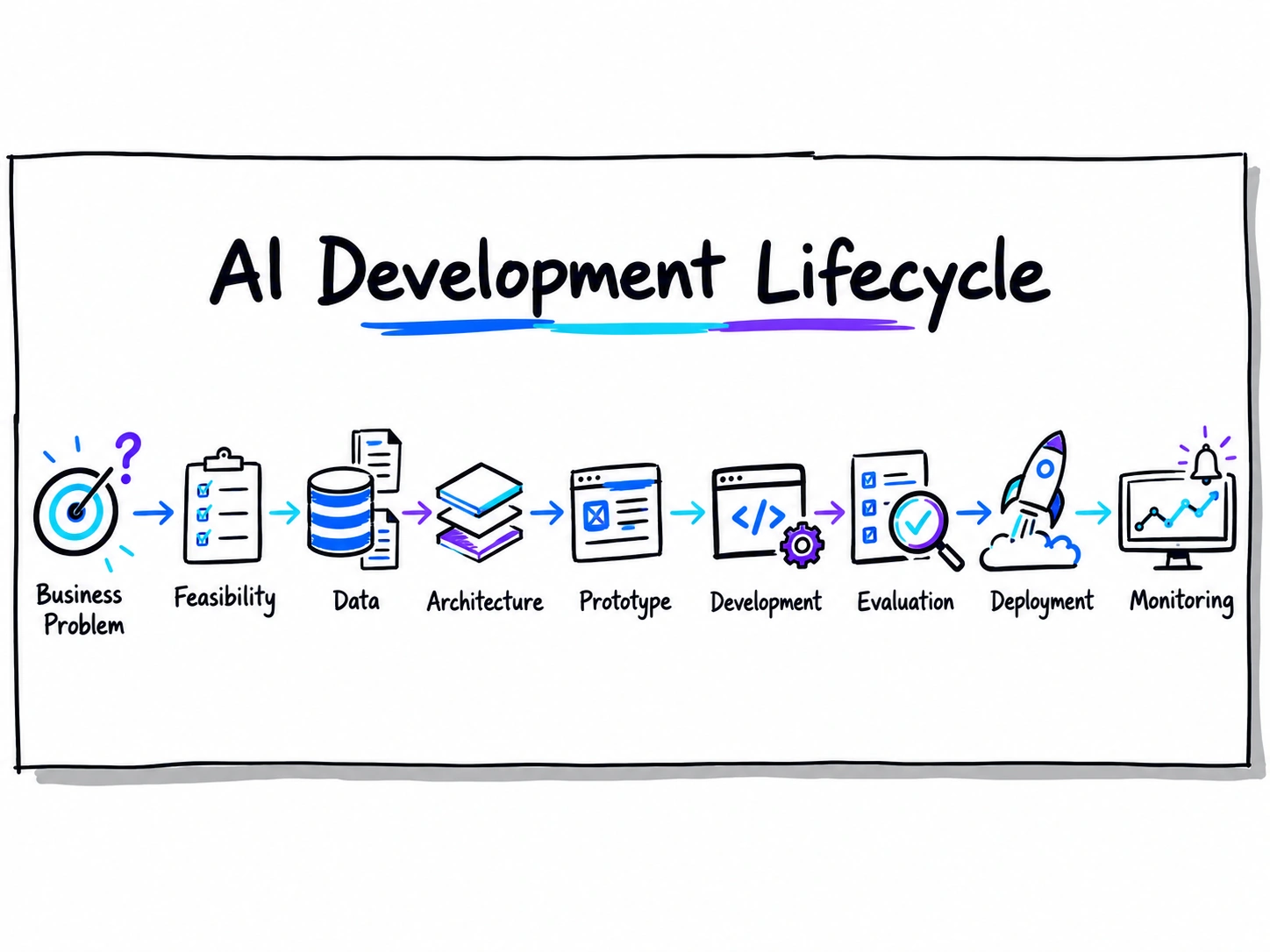
A strong AI development process begins with the business problem, not the model.
A practical lifecycle looks like this.
1. Define the problem
Start with a workflow, bottleneck, decision or customer problem.
Weak starting point:
We need an AI chatbot.
Better starting point:
Our support staff spend several hours each day answering questions already documented in internal product manuals.
The second statement gives the engineering team something measurable.
The team can now investigate whether AI is appropriate, what data is needed and how success should be evaluated.
2. Define the expected outcome
Every project should have a success condition before development begins.
Possible measures include:
- Response accuracy
- Time saved
- Reduction in manual work
- Conversion improvement
- Issue-resolution time
- Retrieval accuracy
- Successful task completion
- Escalation rate
- Cost per transaction
Avoid treating “the demo looks impressive” as a production KPI.
3. Assess data and knowledge sources
The AI can only work with the information available to it.
Teams should identify:
- Internal databases
- Documents
- APIs
- Knowledge bases
- CRM records
- Analytics data
- Product data
- User-generated information
- Third-party sources
The assessment should also consider data quality, ownership, permissions, freshness, privacy and how information will be updated.
A RAG assistant built on outdated documentation will confidently surface outdated information.
That is an information architecture problem, not just a model problem.
4. Choose the right AI approach
The solution may involve:
LLM prompting – when the task mainly requires language reasoning or generation.
RAG – when answers need to be grounded in proprietary or frequently changing knowledge.
Fine-tuning – when behavior or output patterns need specialized adaptation and prompting alone is insufficient.
Machine learning – when prediction from structured historical data is the central requirement.
AI agents – when the system needs to select tools and complete multi-step actions.
Rules plus AI – when deterministic business constraints should remain outside the model.
Many production applications use several of these together.
5. Design the architecture
A common production AI architecture may contain:
Application layer: Web, mobile, internal application, chatbot, or API.
Orchestration layer: Controls prompts, workflows, tool calls and decision logic.
Model layer: Hosted models, specialized models, or private model infrastructure.
Knowledge layer: Documents, relational databases, vector databases and business data.
Integration layer: CRM, ERP, payment systems, SaaS platforms and internal APIs.
Evaluation layer: Automated tests and human review measuring response and task quality.
Security layer: Authentication, authorization, data controls, audit logs and model safeguards.
Monitoring layer: Latency, errors, token usage, inference cost, quality and operational performance.
The exact architecture should follow the use case rather than a standard diagram copied between projects.
6. Build a focused prototype
The purpose of a proof of concept is to answer the riskiest question early.
For a RAG system:
Can we retrieve the correct evidence reliably ?
For an agent:
Can the system choose and execute the correct action ?
For prediction:
Does the available data contain enough signal to produce useful predictions ?
For generative AI:
Can output quality meet the required standard consistently ?
A narrow prototype can prevent months of investment in an idea whose underlying assumptions do not hold.
7. Build and integrate the AI application
Once feasibility has been demonstrated, engineering shifts toward production concerns.
That usually includes:
- Backend APIs
- Authentication
- Workflow logic
- Databases
- Application UI
- Tool integration
- Error handling
- Retries
- Logging
- Queues
- Caching
- Rate limits
- Human-review workflows
This is why experienced AI development services require more than prompt engineering.
The AI component has to live inside reliable software.
8. Evaluate the system
Evaluation should be designed before launch.
For a customer-support assistant, teams might maintain a set of representative questions with expected answers.
For an agent, evaluation might measure:
- Task completion
- Wrong-tool selection
- Unnecessary escalation
- Failed actions
- Policy violations
For RAG:
- Retrieval precision
- Citation correctness
- Answer faithfulness
- Refusal behavior
Human review remains useful for qualitative dimensions that are hard to reduce to a single score.
9. Deploy gradually
High-impact AI systems should usually be introduced progressively.
Common patterns include:
Shadow mode: AI makes decisions but cannot act.
Human approval: AI recommends an action that a user confirms.
Limited autonomy: only low-risk actions execute automatically.
Expanded autonomy: additional permissions are added after evidence shows the system is reliable.
This staged approach is particularly important for agents with access to business systems.
10. Monitor and improve
AI applications are not finished at launch.
Teams should continue monitoring:
- Output quality
- Retrieval failures
- Task completion
- User feedback
- Latency
- Model errors
- Cost
- Escalation
- Data changes
- Unexpected behavior
Models change. Business data changes. User behavior changes.
The application needs a feedback loop.
What Does a Modern AI Application Architecture Look Like ?
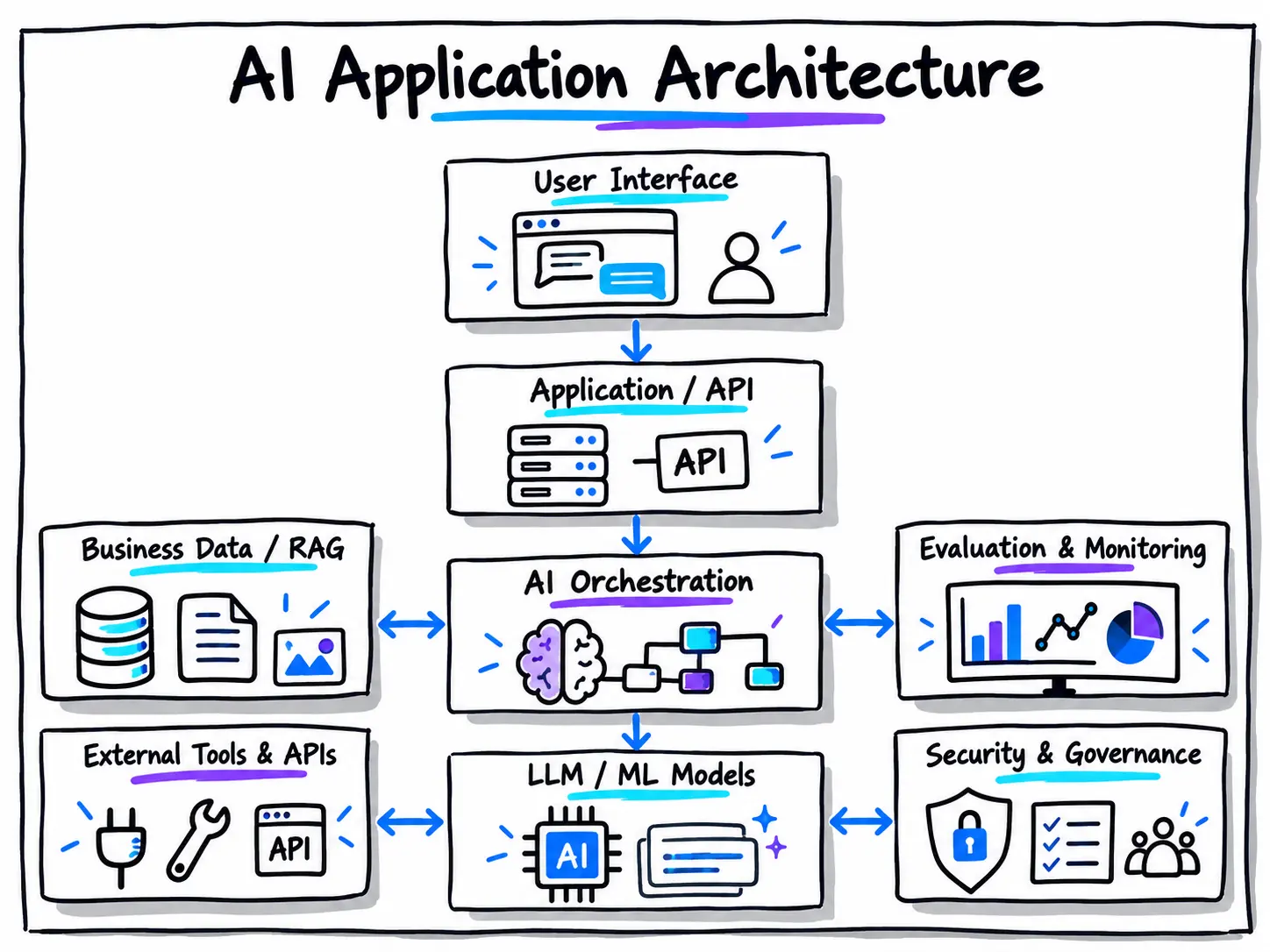
For many business applications, a useful mental model is:
User → Application → AI orchestration → Model + business data + tools → validation → result
The important part is everything surrounding the model.
Imagine an internal purchasing assistant.
The LLM may understand the user’s request, but the system still needs to:
- Verify the user’s identity
- Understand their permissions
- Retrieve current supplier data
- Check purchasing rules
- Query inventory
- Request an approval if required
- Call the procurement system
- Record the transaction
- Provide an audit trail
A model alone cannot safely replace that architecture.
Good AI engineering defines where probabilistic reasoning is useful and where deterministic rules must remain in control.
How Do Businesses Choose the Right Type of AI ?
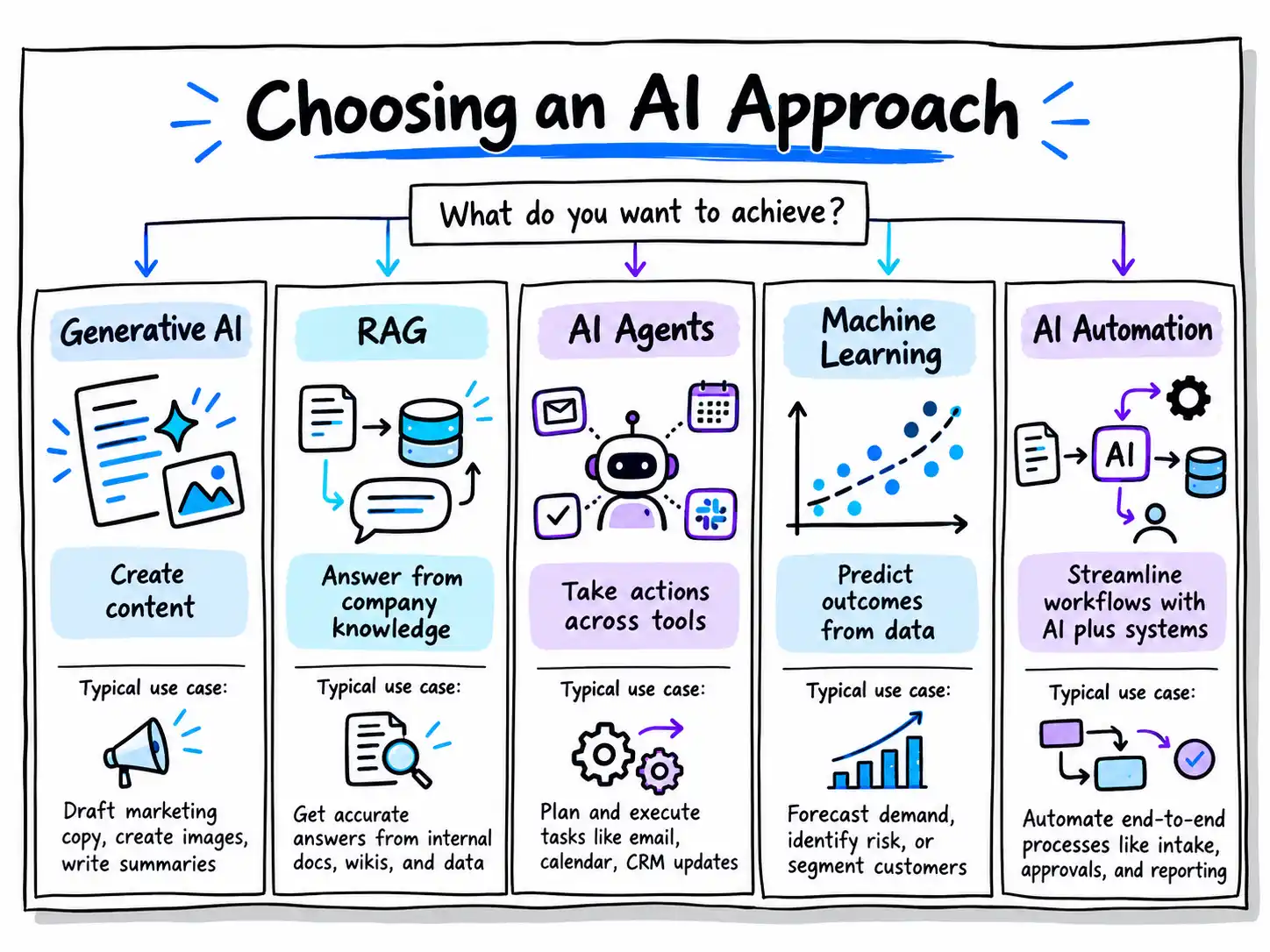
Start with the job the system needs to perform.
| Business Need | Likely Starting Approach |
|---|---|
| Answer questions from company documents | RAG / knowledge assistant |
| Generate content | Generative AI |
| Take actions across business systems | AI agent |
| Predict future outcomes | Machine learning |
| Classify or route information | ML or LLM classification |
| Extract information from documents | Document AI + LLM/ML |
| Automate a complex workflow | Rules + integrations + AI |
| Add intelligence to an existing product | AI application integration |
| Recommend relevant items | Recommendation model |
| Analyze natural-language feedback | LLM/NLP pipeline |
The important word here is starting.
Production applications frequently combine approaches.
For example, an AI support agent may use RAG to find policies, an LLM to reason about the request, deterministic rules to enforce refund limits and APIs to create a ticket or process an approved action.
Common AI Development Use Cases
Here are some of the most practical ways businesses are using AI to improve products, workflows and operations:
Customer support
AI can answer routine questions, summarize cases, recommend next actions, retrieve account information, and help support staff resolve requests faster.
Human escalation should remain available where ambiguity, financial impact, sensitive information or customer frustration requires judgment.
Internal knowledge management
Organizations often have useful information spread across documents, shared drives, wikis and business systems.
A grounded knowledge assistant can make that information searchable through natural-language questions while retaining links or citations to original sources.
Workflow automation
AI can support workflows involving:
- Document review
- Data entry
- Routing
- Email processing
- CRM updates
- Report preparation
- Exception detection
The biggest gains often come when AI is connected to the workflow rather than sitting in a separate chat window.
AI-powered product features
Existing digital products can add:
- Conversational interfaces
- Recommendations
- Summarization
- Smart search
- Document analysis
- Personalization
- Content generation
- Intelligent assistance
The product team should still ask whether the AI improves the user’s core job rather than adding AI simply for differentiation.
Data analysis and prediction
Machine learning can help organizations detect patterns in historical data and support decisions involving demand, churn, fraud, maintenance, pricing or risk.
A Real Example: AI Agent Development for Freight Operations
A useful example of production AI development is Air Brite Labs’ freight dispatch agent.
The freight brokerage’s dispatchers were managing 25–30 active loads at a time and spending significant effort on repetitive carrier check calls, TMS updates and exception handling. The solution was not designed as a general chatbot. Instead, the agent was given a specific toolset for carrier communication, TMS queries, status updates and human escalation.
The implementation also followed a staged autonomy model. It began with a limited prototype on 50 loads where dispatcher approval was required, expanded after testing, ran in shadow mode against real dispatcher decisions and only then received autonomy for routine actions.
According to the published case study, delay detection fell from 3–4 hours to under 20 minutes, dispatchers recovered roughly 60% of time previously spent on routine check calls, and the operation absorbed a 30% increase in load volume without additional dispatch headcount.
The broader lesson is more important than the specific technology:
Successful AI development starts by defining a bounded job, tools, permissions, failure conditions and human handoffs.
What Determines AI Development Cost ?
There is no reliable universal price for AI development because the scope behind the phrase can range from one AI-assisted feature to an enterprise platform spanning multiple systems.
The largest cost drivers usually include:
Scope
A single summarization feature is very different from an agent that coordinates several business systems.
Data readiness
Clean, structured information reduces implementation work.
Projects become more complex when teams first need to:
- Clean data
- Migrate documents
- Build pipelines
- Resolve duplicates
- Create metadata
- Establish access permissions
Model strategy
Costs differ depending on whether the project uses:
- Hosted APIs
- Open-weight models
- Fine-tuned models
- Multiple models
- Specialized inference infrastructure
Integrations
Connecting the AI to CRMs, ERPs, legacy applications, internal APIs or third-party software can represent a large share of engineering effort.
Evaluation requirements
A casual internal assistant may tolerate more uncertainty than a system supporting financial, legal, healthcare or operational decisions.
Higher-risk applications need stronger validation and auditability.
Security and compliance
Authentication, permissions, private networking, encryption, data residency, audit logs and governance requirements can substantially affect architecture.
Production volume
AI costs do not end with development.
Usage-based expenses may include:
- Model inference
- Embeddings
- Vector search
- Databases
- Logging
- Cloud infrastructure
- Observability
A useful cost estimate therefore needs both build cost and ongoing operating cost.
How Long Does AI Development Take ?
AI project timelines depend less on the word “AI” and more on uncertainty.
A focused proof of concept can often be evaluated relatively quickly when:
- The problem is narrow
- Data is accessible
- Integrations are simple
- Users and success metrics are known
Production delivery takes longer when the project involves:
- Multiple systems
- Sensitive data
- Legacy integrations
- Extensive RAG ingestion
- Complex agents
- Approval workflows
- Regulated environments
- Custom model work
- High reliability requirements
A useful plan separates feasibility validation from production engineering.
Do not commit an entire production budget before the highest-risk technical assumption has been tested.
AI Security, Governance and Risk Management
AI systems introduce normal application-security risks plus risks that are specific to model-driven applications.
NIST’s AI Risk Management Framework is designed to help organizations manage AI risks throughout the design, development, deployment and use of AI systems. It emphasizes trustworthy characteristics including reliability, safety, security, transparency, privacy and fairness.
For LLM and generative AI applications, OWASP specifically identifies risks including prompt injection, sensitive-information disclosure, supply-chain vulnerabilities, data/model poisoning, improper output handling and excessive agency.
Practical controls may include:
- Least-privilege tool permissions
- User authentication
- Role-based access
- Input validation
- Output validation
- Secrets management
- Audit logging
- Data classification
- Human approval for sensitive actions
- Rate and spend limits
- Retrieval permissions
- Adversarial testing
- Monitoring
One particularly important principle for AI agents is limited agency.
If an agent only needs to read shipment status and send a reminder, it should not receive unrestricted access to modify every record in the underlying system.
Common AI Development Mistakes
Here are some of the most common mistakes that can reduce the quality, reliability and long-term success of AI projects:
1. Starting with the model instead of the problem
“Let’s use an LLM” is a technology decision, not a business requirement.
Begin with the workflow.
2. Building a demo without an evaluation plan
A few impressive examples do not prove reliability.
Create representative test cases before production.
3. Giving an agent too much authority
Autonomy should be earned through testing.
Start with narrow permissions.
4. Ignoring data quality
Poor retrieval, outdated documents and inconsistent records cannot be solved simply by using a more capable model.
5. Assuming RAG eliminates hallucinations
RAG can improve grounding, but retrieval can fail and models can still misinterpret evidence.
Measure both retrieval and answer quality.
6. Ignoring latency and operating cost
A technically accurate workflow may still fail commercially if each request takes too long or costs too much.
7. Automating judgment that should remain human
AI does not need to own every decision to create value.
In many systems, the best architecture is:
AI handles volume; people handle exceptions and judgment.
8. Launching without monitoring
Production AI behavior should be observable.
Teams need to know when quality, cost or failure patterns change.
When Should a Business Not Use AI ?
AI is not automatically the best solution.
A conventional software feature may be better when:
- Rules are completely deterministic
- The output must always be identical
- A simple database query solves the problem
- There is not enough relevant data
- The consequences of probabilistic errors are unacceptable
- The expected business value does not justify ongoing model costs
For example, calculating a fixed tax rate from a defined table does not require an LLM.
The ability to say “this problem does not need AI” is part of good AI development.
How to Evaluate AI Development Services
When evaluating an AI development partner, look beyond model names.
A capable team should be able to explain:
1. The business case
Why is AI appropriate for this problem ?
2. Architecture
How will the model, data, application, APIs and business systems work together ?
3. Evaluation
How will quality be measured before and after deployment ?
4. Data strategy
Where will the system get its information, and how will freshness and permissions be maintained ?
5. Security
What data reaches the model? What can the system access? Which actions require approval ?
6. Failure behavior
What happens when the model does not know the answer ?
7. Production operations
How will the system be monitored, maintained and improved ?
8. Cost control
How will inference usage and infrastructure costs be tracked ?
A strong team should be comfortable discussing where AI should not be used as well.
What Makes an AI Application Production-Ready ?
A production-ready AI system is not one that produces impressive responses during a demonstration.
It should be:
Useful: It solves a meaningful user or business problem.
Measurable: Its quality can be consistently evaluated using clear metrics.
Grounded: It uses appropriate and current information.
Secure: Users, data and tools have controlled access.
Observable: Teams can detect failures and performance changes.
Cost-aware: Usage economics are understood.
Recoverable: Failures have defined fallback behavior and recovery paths.
Maintainable: Data, models, prompts and integrations can evolve.
Human-aware: People remain involved where judgment or accountability matters.
That is the difference between experimenting with AI and engineering AI into a dependable product.
Final Takeaway
AI development is best understood as building reliable software around intelligent models.
The model matters, but so do the data, application architecture, integrations, evaluation system, security boundaries, monitoring and human workflows surrounding it.
Businesses usually get better results when they begin with one clearly defined problem, validate the riskiest assumptions quickly, measure quality and expand only after the system proves useful.
The goal is not to use as much AI as possible.
It is to use the right amount of AI in the right parts of the product or workflow.
Start with the task, not the technology. Use RAG when the system needs to answer from company knowledge, AI agents when it must take actions across tools, machine learning for prediction and generative AI for creating or transforming content. Many real applications combine more than one approach.
You need access to the data, documents, APIs or business systems required for the AI to do its job. More importantly, that information should be reasonably accurate, current, permissioned and usable. Poor data quality can limit an AI system even when the underlying model is strong.
For most AI projects, a focused proof of concept is the safer starting point. It should test the biggest uncertainty such as retrieval accuracy, model quality, tool use or workflow feasibility before you invest in full production engineering.
A production-ready AI system should do more than work in a demo. It needs defined evaluation metrics, predictable failure handling, security controls, monitoring, cost visibility, reliable integrations and clear human escalation rules where mistakes could have meaningful consequences.
Building in-house can make sense when you already have the engineering, data, AI, infrastructure and security expertise required to maintain the system long term. An external AI development company can be more practical when you need specialized architecture, faster validation, complex integrations or help moving an AI idea from prototype to a production-ready application.